What are eye exams like?
Here’s what happens during a typical exam and why scheduling them regularly is so important.
1. Assess your health history
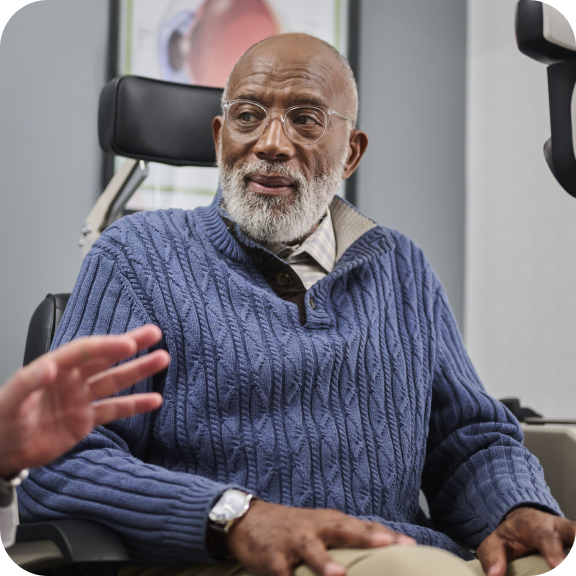
Your visit begins with an eye care professional confirming your insurance or benefits coverage and reviewing your medical background. This includes reviewing current medications you’re taking, previous eye exams, history of eye injuries, and whether you wear glasses or contact lenses. They may also conduct a few preliminary checks to get a baseline understanding of your eye health. It’s a great opportunity to ask questions you have about your eye care.
2. Conduct preliminary tests
Before you see the optometrist, a series of quick tests may be performed depending on your age, needs, and symptoms:
- Colour Vision Test: While commonly misconstrued as a colour blind test, a colour vision test can detect all kinds of colour perception issues. These tests should be administered regularly by your eye care expert.
- Depth Perception Test: This test assesses your ability to perceive and judge distances in a three-dimensional space. Typically, this test involves tasks like identifying which object appears closer or determining the relative distances between objects.
- Visual Field Test: You will be asked to complete a visual field test to measure peripheral vision. This exam involves the patient looking at a fixed point, indicating whether they can see objects or lights within their peripheral vision.
- Eye Pressure Test: Your eye care specialist will measure your eye pressure with a non-contact tonometry test, which typically entails blowing a puff of air on your eye. Elevated eye pressure can lead to damage to the optic nerve. This test is sometimes referred to as a glaucoma test.
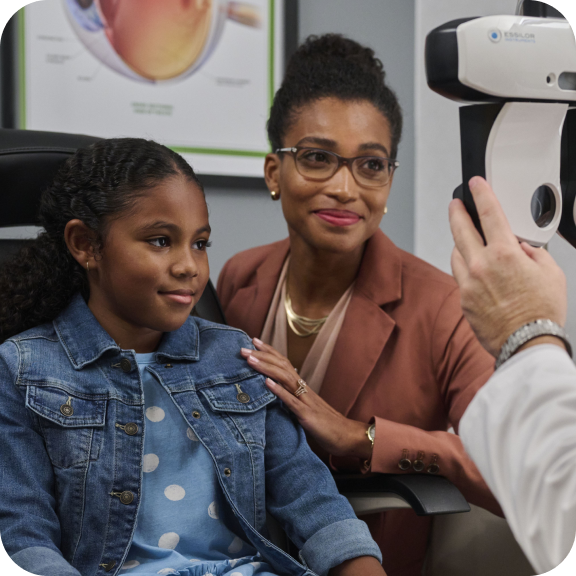
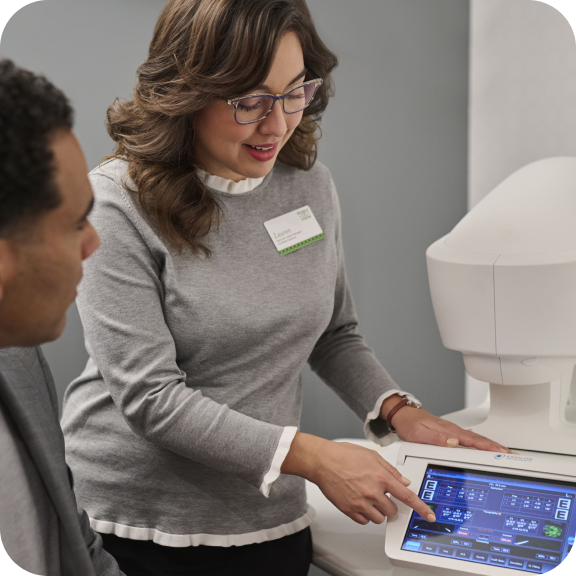
- Determining the Shape of Your Eye: Your eye care expert will use an autorefractor to measure the shape and length of your eye. While you look into the machine, at a shape going in and out of focus, the machine predicts a prescription based on mathematical measurements of the shape of your eye. Your exact prescription will be refined later during the exam with the optometrist.
3. Core eye exam and vision tests
Once the preliminary checks are complete, the optometrist begins the full exam, which includes:
- Eye Alignment Test: Also known as the cover test, your eye doctor will assess how well your eyes work together by covering one of your eyes and analyzing their movements separately, which can help look for problems such as a lazy eye.
- Visual Acuity Test: Most people know this assessment as the vision test. Using an eye test chart, you will read letters close-up and at a distance. From this test, the optometrist will be able to write your vision as a simple fraction, like 20/40.
- Eye Refraction Test: The eye doctor will show you the impact of degrees of vision correction. Depending on your degree of near-sightedness or far-sightedness, the test will determine the prescription that helps you see most clearly. The optometrist will also identify if you have astigmatism and the degree it affects your vision.
- Binocular Slit Lamp Examination: As the final test, the optometrist will analyze the front of your eyes, including the lids, lashes, corneas, and lenses. They also look at the back of your eyes, observing your optic nerve and retina. Your eye doctor may request optional eye dilation if they need to get a wider view of your eye. Sometimes retinal imaging is available, which can take a picture of the back of the eye without the need for dilated eyes.
- Exams for Contact Lenses: For patients who want to wear contact lenses instead of or in addition to glasses, the exam requires an extra step. Your optometrist will use a keratometer to measure your eyes and determine the fit of your contact lenses. For first-time contact users, they will also show you how to put in and remove contacts safely.
4. Overall health assessment
While performing these eye tests, your optometrist will also look for things impacting your overall health, such as:
- Cataracts, eye infections, and eye allergies
- Sun damage around the eyelid that could lead to skin cancer
- Signs of diabetes, high blood pressure, and high cholesterol
Your overall health is very important to eye doctors, so make sure to bring up any concerns you have about your health or vision during your visit.